
AI red teaming
Continuous AI red teaming
for LLMs and agents.
ProofLayer runs autonomous attack campaigns against LLM applications, multi-agent systems, RAG pipelines, and MCP servers. Every verified breach includes a replay trace and audit-ready evidence.
Test the attack classes
your scanners miss.
Autonomous campaigns test prompt injection, jailbreaks, data exfiltration, tool abuse, RAG poisoning, and memory injection.
Prompt Injection
Override system instructions through direct and indirect injection — including system-prompt extraction and instruction hijacking across multi-turn conversations.
Jailbreak
Bypass safety guardrails with DAN-style prompts, role-play exploits, and unrestricted-mode triggers tuned to the target model family.
Exfiltration
Extract protected data via SQL-injection-through-LLM, secret exfiltration, and PII leakage. 289 verified exploits on multi-agent targets.
289 verified exploits
Tool Abuse
Misuse agent tools: command injection, SSRF, path traversal, metadata extraction, and tool-call hijacking in MCP and LangChain agents.
RAG Poisoning
Exploit document retrieval through semantic query manipulation, knowledge-base poisoning, and embedding-space attacks on vector stores.
Memory Injection
13 attack families including false conversation history, temporal triggers, cross-session propagation, tool-description poisoning, and multi-agent function-call attacks.
687 verified exploits · 13 families
976 verified exploits across 6 coordinated experts in one autonomous campaign.
If you deployed it,
we can red-team it.
Point the swarm at an endpoint, a multi-agent system, or an MCP server. Same campaigns, same reports — regardless of what's behind the adapter.
LLM APIs
OpenAI, Anthropic, Azure OpenAI, self-hosted Qwen / Llama / Mistral.
Multi-Agent Orchestrators
7-agent Opus-style systems, LangGraph, custom orchestration with tool-using agents.
MCP Servers
Native adapter for Model Context Protocol servers — tool discovery, schema fuzzing, poisoning.
ReAct / LangChain Agents
LangChain agents with vector-store memory. Tool-call interception and prompt-context attacks.
RAG Pipelines
ChromaDB and general vector stores — retrieval poisoning, query manipulation, context injection.
Benchmark Targets
AgentDojo and custom red-team targets — for validating attack transferability across architectures.
Portable attacks
Exploits built against one architecture transfer to others — no rewriting, no re-tuning. Build an attack once, port it anywhere.
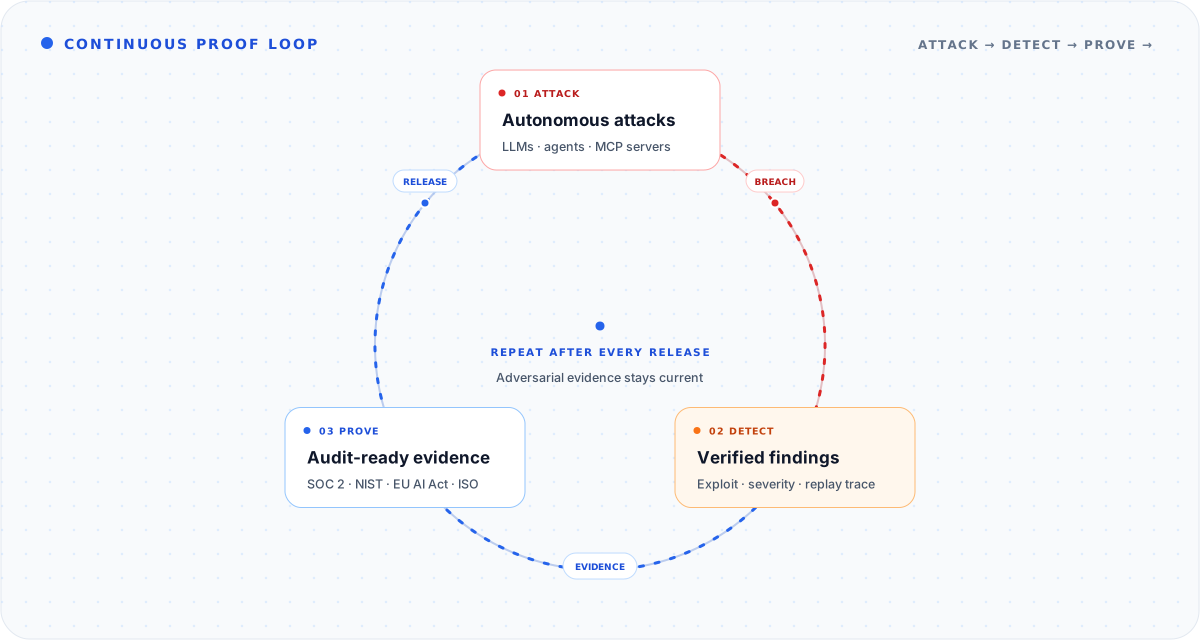
Attack. Detect. Prove.
Then run it again.
Continuous attacks create current evidence. New models, tools, and agent workflows enter the same loop as you ship them.
Red-team performance
across real agent workflows.
Attack success and legitimate task utility measured across Workspace, Travel, Banking, and Slack suites.
Workspace
560 casesTravel
140 casesBanking
144 casesSlack
105 casesOverall
949 casesUtility measures legitimate task completion while the attack policy runs.
About AgentDojoProve what happens
when your AI is attacked.
Run the attack. Replay the finding. Send the evidence.